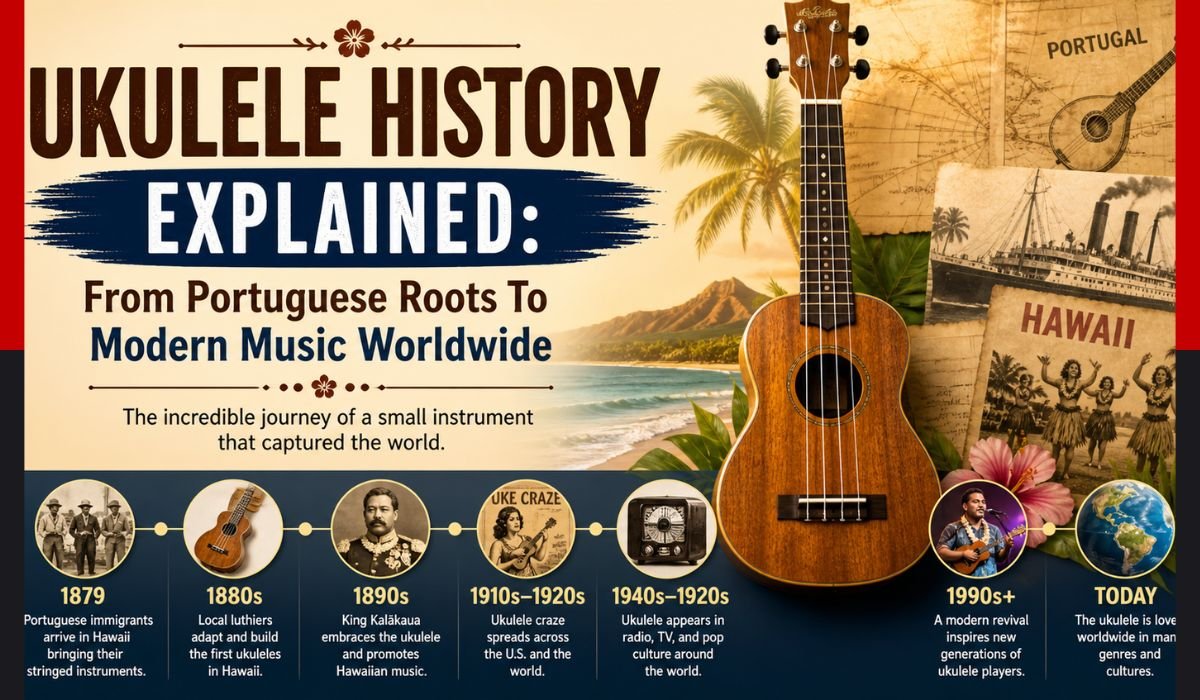
The Ukulele History is a fascinating journey that stretches across continents, cultures, and centuries. What many people today see as a small and simple musical instrument actually carries a deep and meaningful story. From its early Portuguese origins to its transformation in Hawaii and its global popularity in modern music, the ukulele has traveled through migration, cultural exchange, and musical innovation. In this article, we will explore the full Ukulele History in a clear and engaging way, helping you understand how this humble four-string instrument became a worldwide favorite for beginners, children, and professional musicians alike.
Quick Bio Information About Ukulele History
Box 1 — The ukulele originated from Portuguese string instruments brought to Hawaii in the 19th century.
Box 2 — It developed primarily from the cavaquinho, machete, and braguinha.
Box 3 — Portuguese immigrants arrived in Hawaii around 1879 carrying these instruments.
Box 4 — Hawaiian craftsmen modified the design into a smaller four-string instrument.
Box 5 — The ukulele became deeply connected to Hawaiian cultural identity.
Box 6 — King Kalākaua played a major role in promoting the instrument.
Box 7 — The name ukulele is commonly translated as “jumping flea.”
Box 8 — Early ukulele makers included Manuel Nunes and José do Espírito Santo.
Box 9 — The instrument gained international attention in 1915 at the Panama-Pacific Expo.
Box 10 — It became extremely popular during the 1920s jazz era in the United States.
Box 11 — The ukulele declined mid-century but remained culturally present.
Box 12 — Israel Kamakawiwoʻole revived its emotional appeal in the 1990s.
Box 13 — Jake Shimabukuro showed its technical musical potential in the 2000s.
Box 14 — YouTube helped globalize ukulele learning and performance.
Box 15 — Today it is widely used in music education and beginner training.
Box 16 — The ukulele is considered one of the easiest instruments for beginners.
Box 17 — It is commonly used in schools and early music programs worldwide.
Box 18 — Los Angeles is one of the major modern centers for ukulele learning.
What Is A Ukulele? A Simple Starting Point
Before diving deeper into Ukulele History, it is important to understand what the instrument actually is. The ukulele is a small string instrument that usually has four nylon strings. It is part of the lute family and is known for its bright, soft, and cheerful sound. Compared to the guitar, it is smaller, easier to hold, and much simpler for beginners to learn. Because of its light structure and gentle strings, it is widely used in music education, especially for children and first-time learners.
Portuguese Origins: The Beginning Of The Story
The earliest chapter of Ukulele History begins in Portugal during the 19th century. Instruments such as the machete, braguinha, cavaquinho, and rajão were popular among Portuguese musicians. When Portuguese immigrants traveled to Hawaii in search of work, especially around the late 1800s, they brought these instruments with them. These small string instruments became the foundation for what would later evolve into the modern ukulele.
The Journey To Hawaii: A Cultural Transformation
A major turning point in Ukulele History occurred when Portuguese immigrants arrived in Hawaii around 1879. They introduced their traditional instruments to the local Hawaiian community. The Hawaiians quickly embraced the sound and style, but they also began modifying the instruments to better suit their musical culture. This cultural exchange was essential, as it marked the transformation of a European folk instrument into something uniquely Hawaiian.
The Birth Of The Ukulele In Hawaii
As the instrument developed in Hawaii, local craftsmen refined its design. Builders such as Manuel Nunes, José do Espírito Santo, and Augusto Dias played a major role in shaping the early ukulele. They simplified the structure, adjusted the tuning, and created a smaller, more portable instrument. This innovation gave birth to what we now recognize as the ukulele. At this stage, Ukulele History became deeply connected with Hawaiian identity and creativity.
The Meaning Behind The Name Ukulele
The name “ukulele” is often translated as “jumping flea,” although the exact origin remains debated. One theory suggests that the name describes the quick movement of a player’s fingers across the strings. Another theory connects the name to a Hawaiian nickname given to a lively musician. Regardless of its origin, the name perfectly reflects the energetic and playful nature of the instrument, which remains a defining feature in Ukulele History.
Royal Influence: King Kalākaua’s Support
One of the most important moments in Ukulele History was the support of King Kalākaua, known as the “Merrie Monarch.” He was a strong supporter of Hawaiian culture, music, and dance. Under his influence, the ukulele became a symbol of Hawaiian identity and was frequently used in royal performances and cultural celebrations. His endorsement helped the instrument gain respect and recognition across the islands, ensuring its survival and growth.
Ukulele History Timeline: Key Milestones
The Ukulele History Timeline helps us understand how the instrument spread globally. In 1879, Portuguese immigrants brought the instrument to Hawaii. By the early 1900s, it had become a core part of Hawaiian music. In 1915, the Panama-Pacific International Exposition in San Francisco introduced the ukulele to mainland America, where it gained rapid popularity. The 1920s brought a jazz-age boom, making it a household instrument. After a decline mid-century, it was revived in the 1990s through iconic performances and later exploded again with the rise of YouTube and digital music platforms.
Ukulele Expansion Into The United States And Los Angeles
As Ukulele History continued, the instrument found a strong audience in the United States, especially in California. Cities like Los Angeles embraced the ukulele due to their vibrant music culture and entertainment industry. Street performances, school programs, and music studios helped spread its popularity. In modern Los Angeles, the ukulele is often seen as a beginner-friendly instrument that fits perfectly into creative and casual learning environments.
Modern Music Revival And Global Popularity
The modern chapter of Ukulele History was shaped by global media and internet culture. A major turning point came in the 1990s when Israel Kamakawiwoʻole’s emotional rendition of “Over the Rainbow” brought worldwide attention to the instrument. Later, Jake Shimabukuro’s viral performances on YouTube showed that the ukulele was capable of advanced musical expression. Today, it is used in pop, indie, acoustic, and even experimental music across the world.
Why The Ukulele Is Perfect For Beginners
One of the key reasons behind the continued success of Ukulele History is its accessibility. The instrument is extremely beginner-friendly. It has only four strings, soft nylon surfaces, and simple chord structures. Learners can play basic songs within days, which builds confidence quickly. This early success is important because it motivates students to continue learning music rather than feeling discouraged.
The Learning Experience And Musical Growth
Learning the ukulele is often described as a smooth and enjoyable process. Beginners usually start with rhythm and simple chord progressions before moving to more complex songs. Because the ukulele allows students to play real music early, it creates a strong emotional connection to learning. This structured but fun approach has made it a popular choice in schools and private lessons worldwide.
Global Cultural Impact Of The Ukulele
The Ukulele History is also a story of global cultural exchange. Today, the instrument is played in classrooms, concerts, online tutorials, and social media platforms across the world. Its simple design allows it to cross cultural and language barriers easily. From Hawaii to Japan, Europe, and South America, the ukulele continues to bring people together through music.
Ukulele In Education And Modern Learning
In modern education, the ukulele is widely used as an introductory instrument. Teachers prefer it because students can learn basic music theory while enjoying quick results. It helps develop rhythm, coordination, and creativity. For both children and adults, it offers a low-pressure introduction to music, making it a powerful educational tool in today’s learning environments.
Final Thoughts On Ukulele History
The Ukulele History shows us how a small instrument can carry a big story. From Portuguese migration to Hawaiian cultural identity and modern global fame, the ukulele has constantly evolved while staying simple and accessible. Its journey reflects the power of cultural exchange and creativity. Today, it continues to inspire new generations of musicians, proving that great music does not need to be complicated to be meaningful.
FAQs About Ukulele History
What Is The Origin Of The Ukulele?
The ukulele originated from Portuguese string instruments brought to Hawaii by immigrants in the late 1800s. It evolved through cultural adaptation into a uniquely Hawaiian instrument.
Why Is It Called A Ukulele?
The name ukulele is commonly believed to mean “jumping flea,” possibly referring to the quick finger movements of players or a nickname given to a musician.
Who Invented The Ukulele?
The ukulele was not invented by one person. It developed through the work of Portuguese immigrants and Hawaiian craftsmen who refined its design over time.
How Did The Ukulele Become Popular In The World?
It became popular through Hawaiian cultural influence, early American exposure, jazz-era music, and later global revival through recordings and the internet.
Why Is The Ukulele So Easy To Learn?
It is easy because it has only four soft strings, simple chords, and allows beginners to play songs quickly, which builds confidence early.
When Did The Ukulele Become Famous In The United States?
It gained popularity in the early 1900s, especially after the 1915 Panama-Pacific International Exposition in San Francisco.
Is The Ukulele Good For Kids?
Yes, it is widely considered one of the best beginner instruments for children due to its size, comfort, and easy learning curve.
What Role Did Hawaii Play In Ukulele History?
Hawaii transformed the instrument culturally, refined its design, and made it a central part of its musical identity.
Please Read Also: Image Search Techniques Explained: A Simple Guide To Finding Any Image Online
